Yikes! February here in Utah means cold and snow. Perfect day than to fix a cup of cocoa, call it your own private Snow Day and hunker down with a good book.
This morning Parenting.com tweeted a list of about 10 really great children's books that are "must reads."
http://www.parenting.com/gallery/books-kids?src=SOC&dom=tw
It made me think of some of my own favorite times with my kids - the ones where we cuddled up and they read to me or I read to them. I loved those times - and I think they did too. Before the days of digital downloads there was the wonderful smell of the whole library right at our fingertips.
"Call of the Wild," "Little House in the Big Woods" and "Ralph and the Motorcycle" were some of our favorites.
Experts say reading to a child even just ten minutes a day can do wonders for their comprehension, vocabulary and their own reading skills. I think it does wonders for imagination, investigation and conversation.
Happy Reading!
Friday, February 8, 2013


Saturday, August 18, 2012
Perhaps...
I'm reading a really interesting book. It's called "Six Essentials to Achieve Lasting Recovery," by Dr. Sterling Shumway and Dr. Thomas Kimball.
I'm not an addict. Unless you count substance abuse of chocolate and Diet Coke. And I do come from a long line of alcoholics.
But I digress. This book is written to families and loved ones, as well as addicts themselves. Each of these six priniciples has universal applications to everyone - which is what I found so surprising. I was kind of expecting another 12 Step treatise. It's different, and somehow even more personal, than that.
Dr. Shumway - who I presume was an addict at one time - shares a story about how he re-enrolled in college after several years. As a returning student, he left a profitable career and brought a wife and children back to academia with him. To hear him tell it (can you do that in a book?), after the first day of school he had a full-blown attack of what the @#$% have I done??!
Well, I'm not going to tell you how it ends. But it really made me think about all the "perhaps" talks I have with myself. Could the nature and substance of our lives really change by altering the way we speak to ourselves? I'm not sure but I'm certainly willing to become my own test subject.
Disclosure: Tom Kimball sent me this book for free. But I promise to buy him a burger next time I'm at Texas Tech.
I'm not an addict. Unless you count substance abuse of chocolate and Diet Coke. And I do come from a long line of alcoholics.
But I digress. This book is written to families and loved ones, as well as addicts themselves. Each of these six priniciples has universal applications to everyone - which is what I found so surprising. I was kind of expecting another 12 Step treatise. It's different, and somehow even more personal, than that.
Dr. Shumway - who I presume was an addict at one time - shares a story about how he re-enrolled in college after several years. As a returning student, he left a profitable career and brought a wife and children back to academia with him. To hear him tell it (can you do that in a book?), after the first day of school he had a full-blown attack of what the @#$% have I done??!
Well, I'm not going to tell you how it ends. But it really made me think about all the "perhaps" talks I have with myself. Could the nature and substance of our lives really change by altering the way we speak to ourselves? I'm not sure but I'm certainly willing to become my own test subject.
Disclosure: Tom Kimball sent me this book for free. But I promise to buy him a burger next time I'm at Texas Tech.
Tuesday, August 7, 2012
Stress Test
I hit the wall today. Yep. A full-on head first crash into the wall of no return - or at least it feels that way.
The pressure of work and church responsibilities, family worries, and school concerns all combined to overload my brain to the point of undiluted frustration. No amount of chocolate, Diet Coke, or other comfort food could, in fact, comfort me.
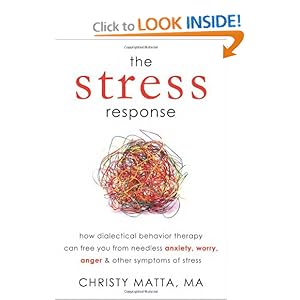
Funny. My melt down comes as I'm reading Chrsty Matta's book, "The Stress Response." Matta claims it's not stress that's bad for us. It's our bodies reaction to stress that's bad for us.
Duh. I could tell you that even before I bought the book. And I'm not even a therapist.
My current stress relief comes in two main forms - food and hiking. Not necessarily in that order. And when those two fail me then I'm really in deep trouble.
Matta says when you're stressed you need to take an inventory of how you're feeling. What's happening with your body? How are you breathing? Are you hot or cold? Jumpy? Washed out?
Then she says you should take inventory of your head. Not whether or not it's still on your shoulders, but what's happening in your brain. What are you thinking about? Are your thoughts rushing through your brain like a freight train? Do they jump from one subject to another? I don't know what I'm supposed to do after I take these notes. Maybe wad them up and throw them at someone or something. I guess I learn that when I read a little farther in the book.
I know the book is based on using DBT skills - or dialectical behavior therapy. I know a little about DBT because one of my colleagues, Craig Smith at Discovery Ranch, uses it with his troubled teen clients. It's something about being mindful and letting choices, not emotions, govern your actions. I don't know much about DBT but Craig's the therapist, not me.
Tomorrow I'll probably feel better. I'll clean off my desk, dust off my determination, and shift the kaleidoscope of my emotions just enough to make me see my world in a different light.
Right now I'm wishing I had a brownie to go with my Gatorade. And it's way too hot for a hike. If you've got a better stress reliever, please share! Just do so at a safe distance.
The pressure of work and church responsibilities, family worries, and school concerns all combined to overload my brain to the point of undiluted frustration. No amount of chocolate, Diet Coke, or other comfort food could, in fact, comfort me.
Funny. My melt down comes as I'm reading Chrsty Matta's book, "The Stress Response." Matta claims it's not stress that's bad for us. It's our bodies reaction to stress that's bad for us.
Duh. I could tell you that even before I bought the book. And I'm not even a therapist.
My current stress relief comes in two main forms - food and hiking. Not necessarily in that order. And when those two fail me then I'm really in deep trouble.
Matta says when you're stressed you need to take an inventory of how you're feeling. What's happening with your body? How are you breathing? Are you hot or cold? Jumpy? Washed out?
Then she says you should take inventory of your head. Not whether or not it's still on your shoulders, but what's happening in your brain. What are you thinking about? Are your thoughts rushing through your brain like a freight train? Do they jump from one subject to another? I don't know what I'm supposed to do after I take these notes. Maybe wad them up and throw them at someone or something. I guess I learn that when I read a little farther in the book.
I know the book is based on using DBT skills - or dialectical behavior therapy. I know a little about DBT because one of my colleagues, Craig Smith at Discovery Ranch, uses it with his troubled teen clients. It's something about being mindful and letting choices, not emotions, govern your actions. I don't know much about DBT but Craig's the therapist, not me.
Tomorrow I'll probably feel better. I'll clean off my desk, dust off my determination, and shift the kaleidoscope of my emotions just enough to make me see my world in a different light.
Right now I'm wishing I had a brownie to go with my Gatorade. And it's way too hot for a hike. If you've got a better stress reliever, please share! Just do so at a safe distance.
Wednesday, April 11, 2012
Race Relations 101
I love Saturdays! Not for the usually reasons of time away from work or time to goof around. Almost every Saturday my grandchildren come to spend the morning. Olivia, 4, and Davis, 18-months, are the light of my life.
We make a big deal out of our Saturday get-togethers. We carefully plan the breakfast menu. Bacon or sausage? Blueberries or strawberries? Cookies for "tea"? We wonder if the weather will be nice enough for a walk. Should we go to the farm store again and see the baby chicks? Livi and D are the only things on my "To do" list for the entire morning.
Sometimes our agenda includes playing with my backyard neighbors, Ashley and Tyson. At eight and five, they're a little older than my grandchildren but the kids don't seem to care. Livi is almost as tall as Ashley. Tyson is a gentle shepherd when it comes to keeping Davis out of trouble. They never let age get in the way of having a good time. Evidently they don't let race matter either.
As I was supervising a good time on the trampoline, Livi commented to Tyson, "I'm black." Gesturing to Davis she added, "He's black. And you're white." Tyson's reply, "Yup."
End of discussion. Beginning of understanding.
We make a big deal out of our Saturday get-togethers. We carefully plan the breakfast menu. Bacon or sausage? Blueberries or strawberries? Cookies for "tea"? We wonder if the weather will be nice enough for a walk. Should we go to the farm store again and see the baby chicks? Livi and D are the only things on my "To do" list for the entire morning.
Sometimes our agenda includes playing with my backyard neighbors, Ashley and Tyson. At eight and five, they're a little older than my grandchildren but the kids don't seem to care. Livi is almost as tall as Ashley. Tyson is a gentle shepherd when it comes to keeping Davis out of trouble. They never let age get in the way of having a good time. Evidently they don't let race matter either.
As I was supervising a good time on the trampoline, Livi commented to Tyson, "I'm black." Gesturing to Davis she added, "He's black. And you're white." Tyson's reply, "Yup."
End of discussion. Beginning of understanding.
Friday, February 10, 2012
Learning through Living
I work for a company that provides help for troubled teens and their families. I'm not a therapist. I'm not a counselor. Most of the time I'm not even a very good mom. Fortunately, they don't factor that in when considering my job performance.
But I often learn interesting things about parenting in general and teen therapy in particular. So I've decided that since I'm not claiming to be an expert on anything, I'm going to start sharing the little stories I run across in the course of my daily work.
Join me in my journey and leave your two-cents worth.
Here's my one of my favorite teen help stories. It's a video about an abandoned horse named DJ. It shows you what awesome people I work with. And really, how great is it to have a job where you can share stories like this?
http://oxbowacademy.net/video?id=rESb3-y8p8U
But I often learn interesting things about parenting in general and teen therapy in particular. So I've decided that since I'm not claiming to be an expert on anything, I'm going to start sharing the little stories I run across in the course of my daily work.
Join me in my journey and leave your two-cents worth.
Here's my one of my favorite teen help stories. It's a video about an abandoned horse named DJ. It shows you what awesome people I work with. And really, how great is it to have a job where you can share stories like this?
http://oxbowacademy.net/video?id=rESb3-y8p8U
Thursday, April 14, 2011
The Power of Example
When I was a kid, at least once a week my mom would make what she called "creamed tuna" for dinner. It is exactly what you're thinking: a can of tuna fish stirred into a thin white sauce and served over toast. It was probably a good way to stretch a can of tuna far enough to feed five kids.
I hated creamed tuna. I vowed that when I was an adult I would never, EVER, fix creamed tuna for my family. After almost 30 years of marriage, I've held true to that vow. There have been tuna casseroles, tuna sandwiches, and tuna salad. But no creamed tuna has ever turned up on our dinner table.
As adults, we often repeat the patterns of our parents no matter how committed we are to avoiding them. From our earliest infancy they become our template for life. And that can have much broader implications than we ever dream.
Recently I was sitting with some young adults who were participating in a Narcotics Anonymous meeting. As addicts, they shared their stories of how they became hooked on drugs or alcohol and the ensuing chaos of their lives.
They almost all began using as tweens living at home. One young man said his father grew marijuana at their home and had no problem sharing it with his son. He described his dad as, "a burned out hippie from the 70's so you know he's got a few brain cells gone." Eventually, the boy moved on to much harder drugs. Even as his son struggled for sobriety, the father could not see the harm in having his stash. No big deal.
Contrast that with the experience of a 20-something young woman in the group. As a young teen, her substance abuse was an occasional drink or pill at a party. But depression and series of drug using boyfriends took her down a road most of us can only imagine. She tried meth and was immediately hooked. She endured her boyfriend's beatings, sometimes even encouraging them, in order to get drugs. She frankly admitted she slept with anyone who could supply her drug needs. She began cutting herself. She was homeless and slept wherever she could find a place to crash - no matter how dirty or vile it may be.
At her lowest point, she said she woke up one morning and looked around. She told the group, "I said to myself, 'My parents taught me better than this. I know better than this.'" She walked out, checked herself into rehab, and has never gone back. Although they divorced when she was a child, this young woman said her parents had created good homes for her and made it a point to teach her right from wrong.
When we think our influence, our example, doesn't matter - it does. When we think our children have tuned us out for the zillionth time - they haven't. When we think our personal, private actions aren't that big a deal - they are.
We are the template for our children's lives. They may not do everything the way we did. But some of the most important decisions they make will be reflections of our own.
I think of these young adults and their daily battle for sobriety almost every day. And I say a silent prayer for them. I am a great believer in prayer. I learned it from my mother.
I hated creamed tuna. I vowed that when I was an adult I would never, EVER, fix creamed tuna for my family. After almost 30 years of marriage, I've held true to that vow. There have been tuna casseroles, tuna sandwiches, and tuna salad. But no creamed tuna has ever turned up on our dinner table.
As adults, we often repeat the patterns of our parents no matter how committed we are to avoiding them. From our earliest infancy they become our template for life. And that can have much broader implications than we ever dream.
Recently I was sitting with some young adults who were participating in a Narcotics Anonymous meeting. As addicts, they shared their stories of how they became hooked on drugs or alcohol and the ensuing chaos of their lives.
They almost all began using as tweens living at home. One young man said his father grew marijuana at their home and had no problem sharing it with his son. He described his dad as, "a burned out hippie from the 70's so you know he's got a few brain cells gone." Eventually, the boy moved on to much harder drugs. Even as his son struggled for sobriety, the father could not see the harm in having his stash. No big deal.
Contrast that with the experience of a 20-something young woman in the group. As a young teen, her substance abuse was an occasional drink or pill at a party. But depression and series of drug using boyfriends took her down a road most of us can only imagine. She tried meth and was immediately hooked. She endured her boyfriend's beatings, sometimes even encouraging them, in order to get drugs. She frankly admitted she slept with anyone who could supply her drug needs. She began cutting herself. She was homeless and slept wherever she could find a place to crash - no matter how dirty or vile it may be.
At her lowest point, she said she woke up one morning and looked around. She told the group, "I said to myself, 'My parents taught me better than this. I know better than this.'" She walked out, checked herself into rehab, and has never gone back. Although they divorced when she was a child, this young woman said her parents had created good homes for her and made it a point to teach her right from wrong.
When we think our influence, our example, doesn't matter - it does. When we think our children have tuned us out for the zillionth time - they haven't. When we think our personal, private actions aren't that big a deal - they are.
We are the template for our children's lives. They may not do everything the way we did. But some of the most important decisions they make will be reflections of our own.
I think of these young adults and their daily battle for sobriety almost every day. And I say a silent prayer for them. I am a great believer in prayer. I learned it from my mother.
Saturday, April 9, 2011
Past Meets Present
I spent this weekend braving 50 mph winds, dropping temperatures and seven inches of new snow to be with my other "family."
We have no biological connection. But all of us have come to experience wilderness therapy in one form or other. As a video producer, it's some of the most difficult work I've ever done. As a mom, I've heard some heart wrenching and inspiring stories of teens who were lost, then found, through their struggles in the wilderness.
This weekend the RedCliff family decided to hold reunion - inviting prior graduates, staff, and parents to meet again in the southern Utah desert. It wasn't about re-creating the wilderness experience that helped these students, now young adults, change their lives. It was an opportunity for them to stand on the summit of their lives thus far and see how far they've come.
Knowing a little bit about how hard wilderness therapy is, it's difficult to imagine anyone would willingly return to such a spartan existence, even it's only for a few days. But come they did. 47 parents and students from as far away as Australia and the UK.
As I sat shivering in the kiva, listening in on my first Narcotics Anonymous meeting, I was amazed to hear their stories of triumph and tragedy - even after leaving RedCliff the first time. Some had stumbled again into drugs or drinking. But all of them referred to their wilderness therapy experience as the first time they had come face to face with themselves their capacity to succeed.
Telling someone you understand wilderness therapy because you've been camping is like telling someone you're a professional ballerina because you've worn dance slippers.
These students, some who graduated as long as seven years ago, were back amongst peers who truly understood and respected what they had accomplished, both in the wilderness and the daily battle for sobriety and strength since then.
They were home. I was honored to be with them.
We have no biological connection. But all of us have come to experience wilderness therapy in one form or other. As a video producer, it's some of the most difficult work I've ever done. As a mom, I've heard some heart wrenching and inspiring stories of teens who were lost, then found, through their struggles in the wilderness.
This weekend the RedCliff family decided to hold reunion - inviting prior graduates, staff, and parents to meet again in the southern Utah desert. It wasn't about re-creating the wilderness experience that helped these students, now young adults, change their lives. It was an opportunity for them to stand on the summit of their lives thus far and see how far they've come.
Knowing a little bit about how hard wilderness therapy is, it's difficult to imagine anyone would willingly return to such a spartan existence, even it's only for a few days. But come they did. 47 parents and students from as far away as Australia and the UK.
As I sat shivering in the kiva, listening in on my first Narcotics Anonymous meeting, I was amazed to hear their stories of triumph and tragedy - even after leaving RedCliff the first time. Some had stumbled again into drugs or drinking. But all of them referred to their wilderness therapy experience as the first time they had come face to face with themselves their capacity to succeed.
Telling someone you understand wilderness therapy because you've been camping is like telling someone you're a professional ballerina because you've worn dance slippers.
These students, some who graduated as long as seven years ago, were back amongst peers who truly understood and respected what they had accomplished, both in the wilderness and the daily battle for sobriety and strength since then.
They were home. I was honored to be with them.
Subscribe to:
Posts (Atom)